How Does Digital Night Vision Work? A Plain-English Guide
Learn how digital night vision turns visible and near-infrared light into a screen image, and why it is different from thermal and analogue systems.
Digital night vision works like a specialised video camera: a lens focuses visible and near-infrared light onto an electronic sensor, a processor turns the sensor signal into frames, and a screen shows the result. When natural light is insufficient, an infrared illuminator sends out light that the sensor can detect after it reflects from the scene; it does not detect heat.
The imaging chain in five steps
Although the finished picture appears almost instantly, it has passed through a clear sequence of components.
- The objective lens gathers light. Light reflected by an animal, tree or building enters the front lens. This may be faint visible light from the moon or sky, near-infrared light already present in the scene, or near-infrared light supplied by the device.
- The lens focuses that light onto a sensor. Digital night vision uses an electronic image sensor rather than an image-intensifier tube. Photosensitive pixels convert incoming photons into electrical signals. The more useful light that reaches those pixels, the stronger the starting signal can be.
- Electronics read and process the signal. The device converts the sensor data into a digital image. Processing can adjust brightness and contrast and manage noise, but it cannot recreate detail that the lens and sensor never captured. Excessive electronic gain may make a dark image brighter while also making grain more obvious.
- A display presents the live view. You are looking at a small screen, not directly through the objective lens. The screen’s resolution and the sensor’s resolution are separate specifications, so one should never be inferred from the other.
- The device may save a copy. Recording electronics can encode photos or video onto a memory card. A stated recording mode describes the output file; it does not by itself prove the native resolution of the sensor or display.
This lens-to-sensor-to-processor-to-screen route is the central infrared night vision process. It also explains why focus, movement, processing delay and screen quality can all affect what the observer sees.
Why infrared illumination is needed
A sensitive sensor can use weak ambient light, but it still needs photons. Under an open sky at dusk, the scene may provide enough reflected light for a useful picture without active infrared. Beneath thick tree cover on a moonless, overcast night, there may be too little, so an illuminator supplies it.
An infrared LED acts rather like a torch for the sensor. It projects near-infrared light; objects reflect some of that light back through the lens; the sensor converts it into an image. Raising the IR level can help when a target is farther away, but more is not automatically better. A pale branch, fence or wall close to the lens can reflect strongly, overexpose the foreground and leave the subject behind it harder to see. Rain, mist and foliage can also scatter or return illumination.
The HotPeak device uses 850nm IR with seven adjustment levels. At this wavelength, the emitter can have a faint red glow, even though the scene illumination itself is outside normal human vision. Starting at the lowest effective level usually gives a more balanced view and avoids wasting battery power.
What the sensor and processor contribute
Low-light image sensors are designed to convert faint visible and near-infrared light efficiently. Sony’s technical explanation of security-camera sensors describes photodiodes converting light into electrical signals and notes the trade-off involved in amplification: increasing gain can brighten a dark image, but it also amplifies noise.
The processor then creates each viewable frame. It may control exposure, gain, colour or monochrome presentation, noise reduction and file encoding, depending on the device. These steps can make the signal easier to interpret, but they do not change the basic requirement for focused, reflected light. There may also be a short delay between the event and its appearance on screen because capture, processing and display take time.
We have not measured the live view’s display latency, so no milliseconds figure appears here. If split-second timing matters to you, judge your own unit against a moving subject rather than relying on an assumed number.
Digital night vision is not thermal imaging
The word “infrared” causes confusion because it covers a broad part of the electromagnetic spectrum. Digital night vision uses reflected visible and near-infrared light to form a camera-like picture. Thermal imaging senses emitted thermal energy and maps differences in heat, without requiring a scene to be lit in the same way.
That distinction has practical consequences. Digital night vision can show surface detail, markings and context when enough light returns to the sensor, but it will not reveal an animal merely because the animal is warm. Our separate guide explains in more depth whether digital night vision detects heat.
Digital equipment is also different from analogue Gen 1, Gen 2 or Gen 3 night vision. Those generation labels refer to systems built around image-intensifier tubes. A digital model uses a sensor, processing electronics and a display, so calling it a particular tube “generation” is misleading.
How this applies to HotPeak
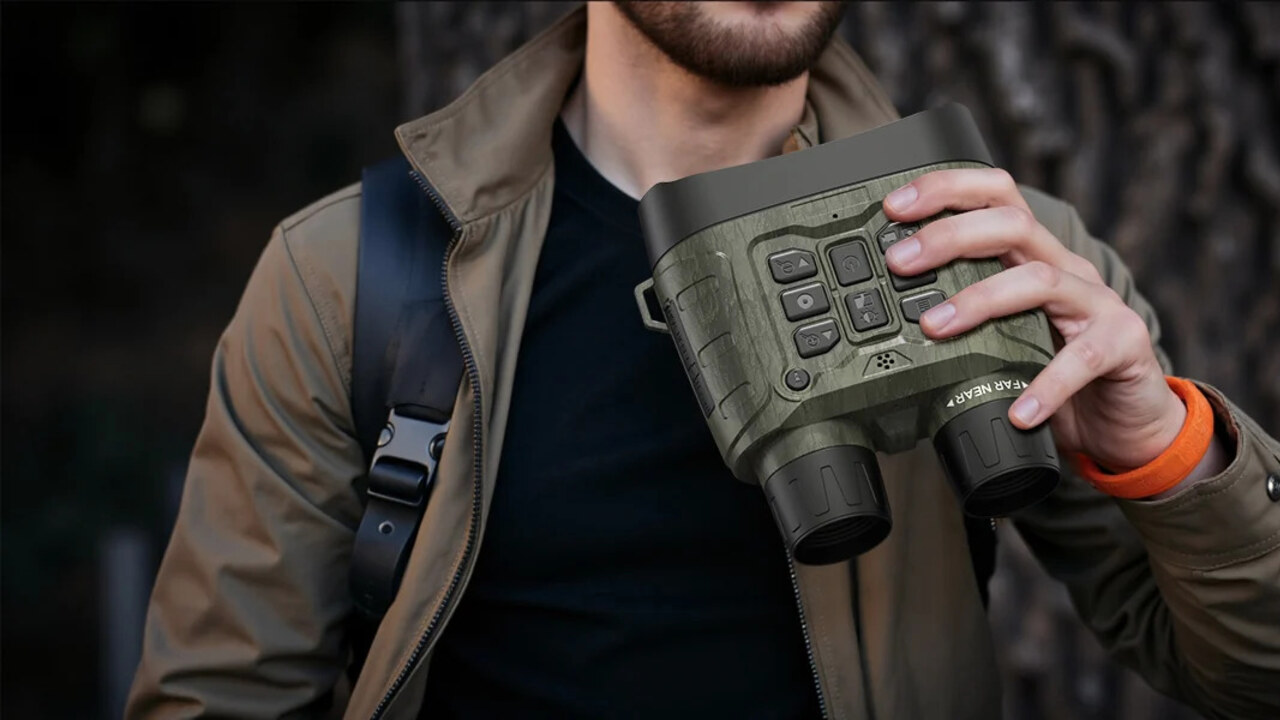
Our HotPeak digital night vision goggles follow this digital camera-style principle. The verified optical specification is an F1.2, f=25mm lens; illumination is adjustable 850nm IR; and the live image appears on a 3.0-inch 800×480 TFT screen. Video sizes in the menu include 4K, 2K, 1088P, 1080P, 720P, VGA and QVGA.
In use, focus first on a stable target, assess the image with available light, then add only as much IR as the scene needs. Keep nearby reflective objects out of the beam and remember that the 5x zoom is digital: it enlarges or crops existing image information rather than adding optical detail.
Frequently asked questions
Can digital night vision work in complete darkness?
It can work where there is no useful ambient light if an infrared illuminator lights the scene. The system still depends on that IR light reflecting from the subject and returning to the sensor.
Does digital night vision amplify heat?
No. It forms an image from reflected visible and near-infrared light. Detecting emitted heat requires a thermal sensor, which is a different technology.
Is digital night vision the same as Gen 1 night vision?
No. Gen 1 is an analogue image-intensifier tube category. Digital night vision replaces the tube with an electronic image sensor, processor and display.